

Tongwu Zhang, Ph.D.

Biography
Dr. Tongwu Zhang received his Ph.D. in bioinformatics from Zhejiang University, China, in June 2012. He conducted part of his doctoral research at the Beijing Institute of Genomics, Chinese Academy of Science, where he worked on whole-genome sequencing and assembly based on different next-generation sequencing technologies. Before joining NCI, he was a visiting scholar at the King Abdulaziz City for Science and Technology, Kingdom of Saudi Arabia. Dr. Zhang joined the Laboratory of Translational Genomics (LTG) as a visiting postdoctoral fellow in July 2012, under the mentorship of Kevin M. Brown, Ph.D. He became a staff scientist and worked with Maria Teresa Landi, M.D., Ph.D., senior investigator, in the Integrative Tumor Epidemiology Branch (ITEB) in October 2017. In 2023, Dr. Zhang was appointed as an Earl Stadtman tenure-track investigator in the Biostatistics Branch (BB).
Dr. Zhang has received numerous awards for his work, including an NCI Director’s Award, NCI Director’s Innovation Award, CCR-DCEG FLEX Award, and several awards from DCEG.
Research Interests
Dr. Zhang studies how inherited genetic variation, environmental exposures, and complex genomic changes shape cancer development, tumor heterogeneity, and evolution. His research combines large-scale whole-genome sequencing with epidemiological and clinical information across cancer types and populations. He develops computational and statistical methods to investigate underexplored dimensions of cancer genomes and uncover interactions between germline variation and somatic changes acquired during tumor development.
Genomic Analyses for Sherlock-Lung
Lung cancer in never smokers (LCINS) accounts for 10%-25% of lung cancer cases and ranks among the most common causes of cancer mortality. The Sherlock-Lung study aims to trace lung cancer etiology in never smokers through a comprehensive multi-omics approach, including conducting whole genome sequencing, whole transcriptome, and genome-wide methylation for tumors and surrounding lung tissue. Dr. Zhang leads genomic analyses and develops new bioinformatic pipelines to 1) characterize the genomic, epigenomic, and transcriptomic landscape of LCINS; 2) identify the exogenous and endogenous mutational processes involved in lung tumorigenesis in LCINS; and 3) study the tumor evolutionary history of LCINS.
Exploring Complex Cancer Genomic Features
The Prism study is a central focus of Dr. Zhang’s research program. His team has assembled a large-scale cancer genomics resource comprising deep whole-genome sequencing data from more than 20,000 tumors across 45 cancer types and their matched normal samples. Through comprehensive analysis of this resource, the team investigates complex genomic features that extend beyond conventional catalogs of driver mutations and commonly characterized genomic alterations.
Prism focuses on extrachromosomal DNA (ecDNA), tandem repeat variation, centromeric sequence and structure, and transposable elements, including LINE-1. The study also examines viral and bacterial sequences detected in tumor sequencing data and investigates their relationships with the host cancer genome. Together, these analyses aim to reveal how repetitive DNA, genome organization, mobile genetic elements, and nonhuman genomic sequences contribute to the diversity of cancer genomes.
A major goal is to determine when these features arise during tumor development and how they influence genomic instability, tumor heterogeneity, and clonal evolution. By integrating information from matched tumor and normal genomes, Dr. Zhang also investigates germline–somatic interactions: how inherited variation influences the emergence and selection of somatic alterations, and how these relationships differ across cancer types and populations. This work seeks to uncover mechanisms of cancer development that remain difficult to resolve through conventional genomic analyses.
Bioinformatics Tools Development for Cancer Genomics and Genetic Study
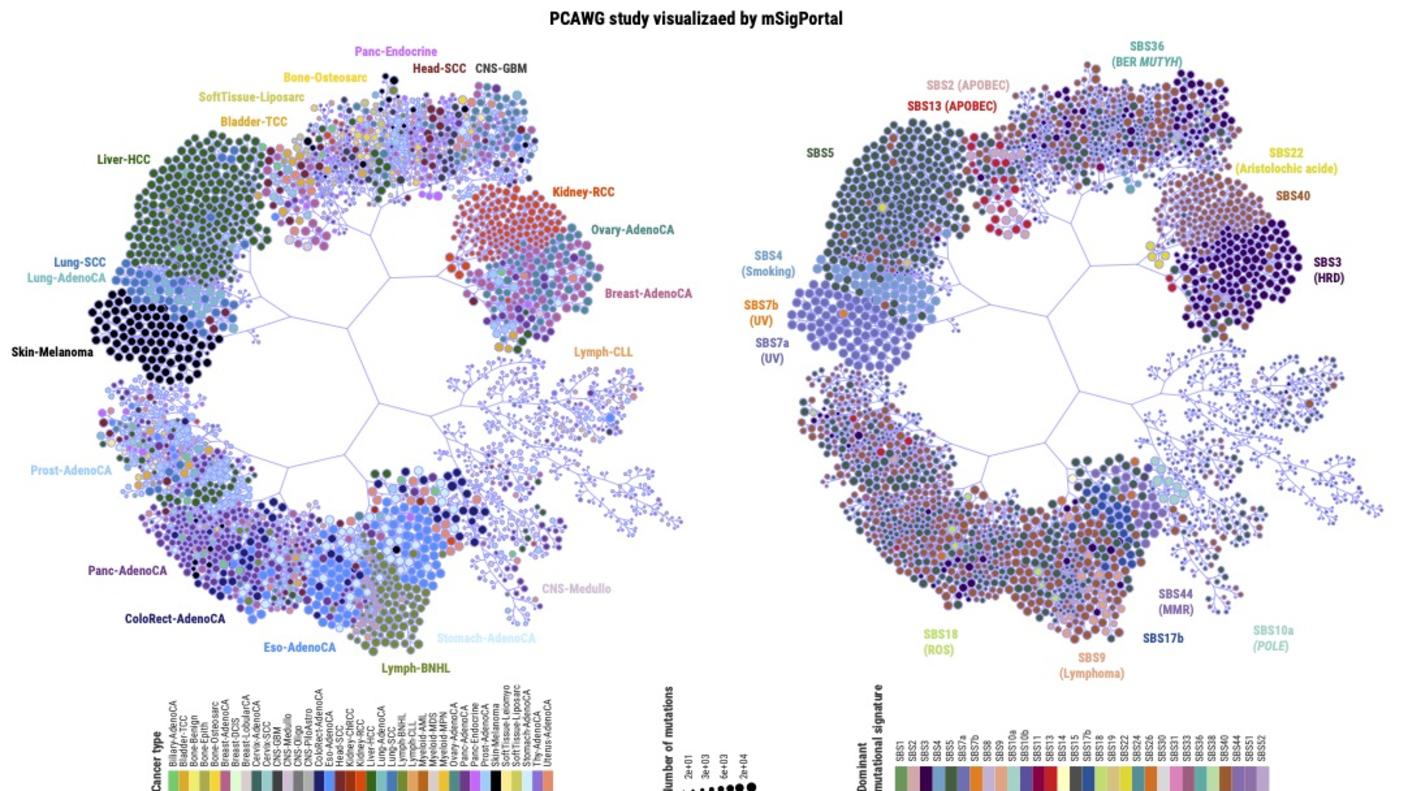
Dr. Zhang develops computational tools and statistical methods to advance cancer genomics and genetic studies. He created ezQTL, a web-based resource for interactive visualization and colocalization analysis of quantitative trait loci (QTL) and genome-wide association study (GWAS) results, and mSigPortal, a platform for exploring and analyzing mutational signatures from public studies and user-provided data. He is also developing PurityNGS to estimate and visualize tumor purity, ploidy, and clonal architecture by integrating somatic copy number alterations, single-nucleotide variants, and cancer cell fraction estimates.
His statistical research includes methods to quantify uncertainty in mutational signature estimates and incorporate it into downstream analyses, improving detection of true associations while reducing false-positive findings. He also develops analysis pipelines to detect and characterize complex genomic features—including extrachromosomal DNA (ecDNA), tandem repeat variation, and transposable element insertions—in large whole-genome sequencing datasets. These methods support integrated analyses of tumor genomic features, germline variation, and epidemiological and clinical information.
Information for Journalists
To request an interview with a DCEG investigator, please complete this form: Request For Comment | HHS.gov.